
JILL GERRIETS
Instructional Designer | eLearning Developer
What do college librarians, medical coders, and instructional designers have in common? We love learning! My life path has traveled through diverse workplaces, but I've dedicated myself to the same approach: pour through all the information available, make sense of it, and then help guide others on their learning journeys.
In my spare time, I enjoy nature walks in all types of weather (usually rainy).
MY WORK
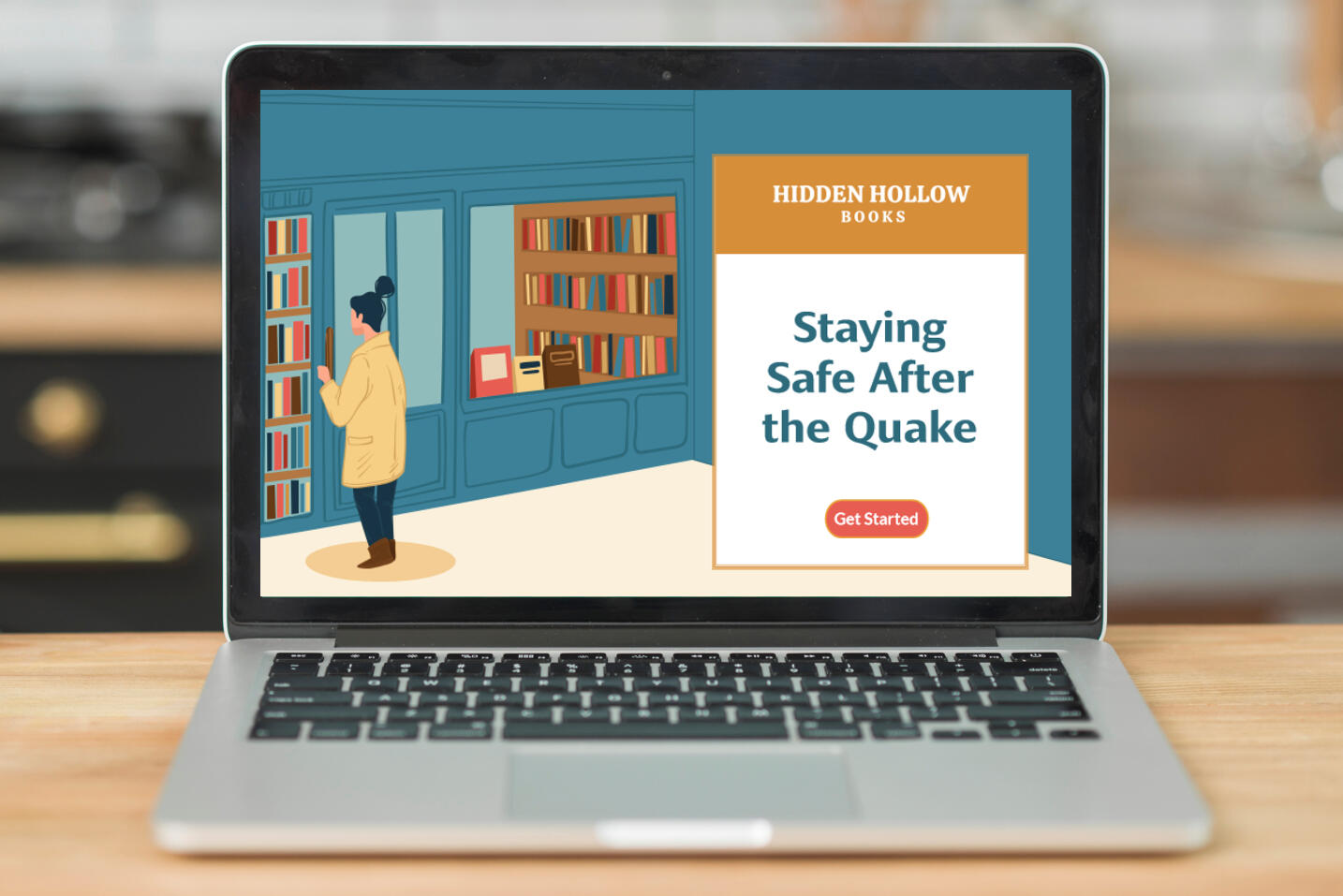
Booksellers at Hidden Hollow Books grow their survival skills for the Cascadia earthquake.


MY PROCESS
Defining and developing high-quality content tailored to adult learners.
EARTHQUAKE SAFETY
Overview: Hidden Hollow booksellers are unprepared to navigate the aftermath of a major earthquake, putting both themselves and store customers at risk for injury. Staying Safe After the Quake is designed to provide booksellers with core survival skills. This interactive, scenario-based course was developed for the eLearning Designer's Academy Hands-on Cohort, March 2026, and was selected for EDA's eLearning Examples Library.
CHALLENGE
Consistently train multiple shifts of Gen Z and early Millennial booksellers on safety following a major earthquake, with design addressing:• Decision-making during post-quake hazards.
• Safety considerations when helping injured or trapped individuals.
• High turnover rates making repeated in-person training inefficient and costly.
• Limited trainer availability and scheduling constraints.
DESIGN & DEVELOPMENT
Designed with freedom of choice and key checkpoints
Booksellers with limited time required a build that was compact and flexible. A multi-option main menu and more open navigation allows learners to direct their own learning. Placing strategic learning checks ensures that learners apply essentials without bogging down in information.
Built for safe practice of core skills
Earthquake survival presents unique challenges, one of which is the fact that it is hard to replicate in real life. This design allows learners to safely practice core skills (like giving help) using scenario-based learning.
Delivers reputable, relevant content with well-defined scope
Due to the extensive resources on earthquake safety and survival, it was essential to scope this project carefully while accounting for neighborhood peculiarities (like unreinforced masonry). This custom-made, thoughtful approach clearly identifies the learners and builds to their experience—no canned tutorials that could fit any organization or situation.TOOLS
Articulate Storyline, Eleven Labs, Freepik, Use All Five, and PowerPoint.
MY PROCESS
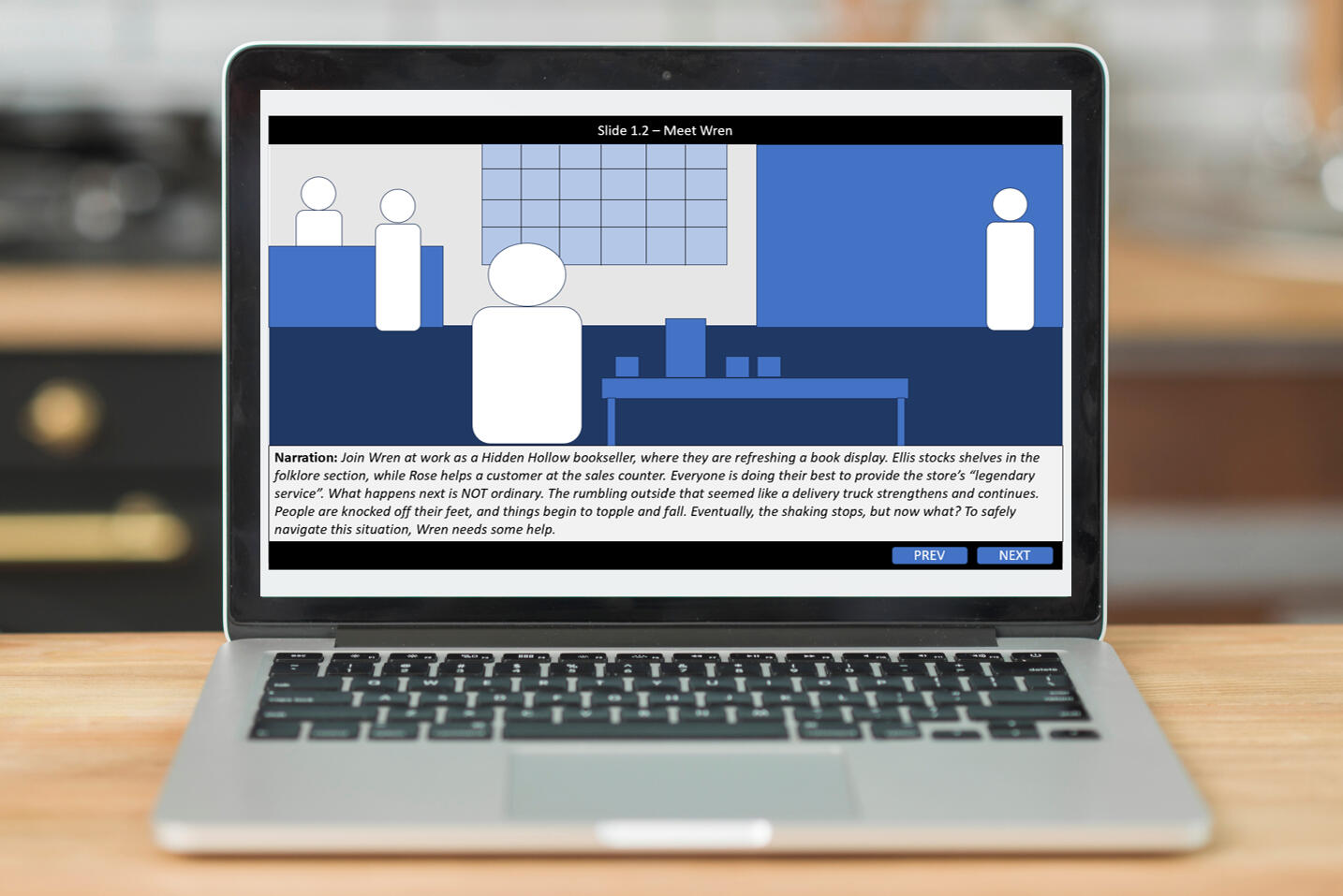
I’m a “full-stack” instructional designer who is interested in guiding the process from start to finish, bringing unique strengths to the design and development process, including:
Expert investigation and information curation
One of the primary challenges of working with subject matter experts is determining what is essential compared to what would be good to know. My experience as a reference librarian helps me get to the heart of the issue. What, exactly, is the work performance issue, and what are the essential nuggets learners should have by the end of training?Thoughtful, complete design
Using mind maps, action maps, blended learning solutions, storyboards, and visual design prototypes, I save time and effort by thoughtfully designing a project so that it is fully developed before production. Major design changes are relatively easy when they’re addressed early on and costly when addressed in the final stages.Engage both learners and stakeholders
Learning for adults requires different methods from children, especially in terms of being aware of both the organizational and learner culture. Building with potential roadblocks in mind removes obstacles from learners’ paths and smooths the way to better performance.Learning in action
As Tim Slade of the eLearning Designer’s Academy has said, “One of Jill’s standout strengths is her ability to take feedback and truly implement it.” My goal for each project is to learn and grow my instructional design skills, and one of the primary ways to do this is to iterate continuously-improved designs.